
Product development in printed electronics is rarely linear. It is an iterative process that combines material science, design optimization, and manufacturing expertise, often requiring multiple prototype rounds before the final solution is ready for scale-up.
Typically, product development at Screentec involves multiple prototypes and variants to explore performance, manufacturability, sustainability, and design feasibility. Each iteration delivers valuable insights that help refine both the product and the production process.
Exploring Materials and Structures Through Prototyping
A key part of Screentec’s product development process is systematic experimentation with materials and structures. In the reference picture, prototypes were produced using a range of conductive pastes, including carbon, copper, and recycled silver. In parallel, different substrate materials were tested, such as paper-based and PET-based electrode structures. Each substrate brings its own advantages and constraints, influencing flexibility, sustainability, cost, and end-use performance. By combining multiple paste and substrate options, Screentec is able to assess how different material combinations behave in real manufacturing conditions.
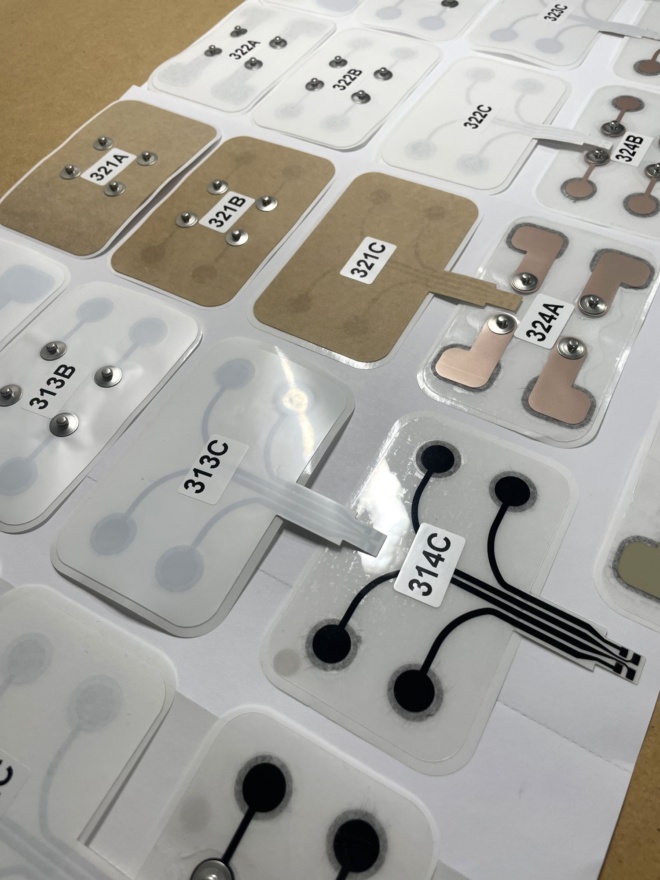
Design and material variations across prototypes.
Design variations are also an essential part of the prototyping phase. Layouts, geometries, and functional structures were adjusted between iterations to optimize usability, reliability, and integration with other system components.
Together, these material choices, combinations, and design variations are evaluated for electrical performance, durability, process compatibility, and environmental impact, enabling the selection of the most suitable solution for each application.
A Typical Product Development Process at Screentec – Case Sustronics
While every project has its own requirements, the Sustronics prototypes illustrate a typical product development and iteration workflow at Screentec:
- Concept and requirements definition
Development begins with a clear understanding of application needs, performance targets, regulatory considerations, and manufacturing constraints. - Initial design and material selection
Based on the requirements, suitable materials, printing technologies, and structural concepts are selected. Sustainability considerations are increasingly part of this phase. - Prototype manufacturing
Early prototypes are produced using scalable printing methods. At this stage, the goal is to validate feasibility rather than perfection. - Testing and evaluation
Prototypes are assessed for electrical performance, mechanical durability, process repeatability, and compatibility with downstream integration. - Iteration and refinement
Findings from testing feed directly into the next design round. Materials, layouts, and process parameters are refined step by step. - Preparation for production
Once the design meets functional, regulatory, and manufacturing requirements, the focus shifts toward repeatability, quality control, and production readiness.
This iterative approach allows risks to be identified early and ensures that the final solution is both technically robust and manufacturable at scale.
Why Iteration Matters in Printed Electronics?
In printed electronics, small changes in materials or design can have a significant impact on performance and yield. Iterative prototyping enables informed decision-making based on real data rather than assumptions. It also supports faster development cycles, as lessons learned from each prototype directly guide the next step.
Turning Prototypes into Production-Ready Solutions
At Screentec, prototyping is an integral part of developing production-ready printed electronic solutions. By combining hands-on manufacturing expertise with close collaboration across development teams and partners, innovative concepts can be systematically matured into reliable, scalable products.