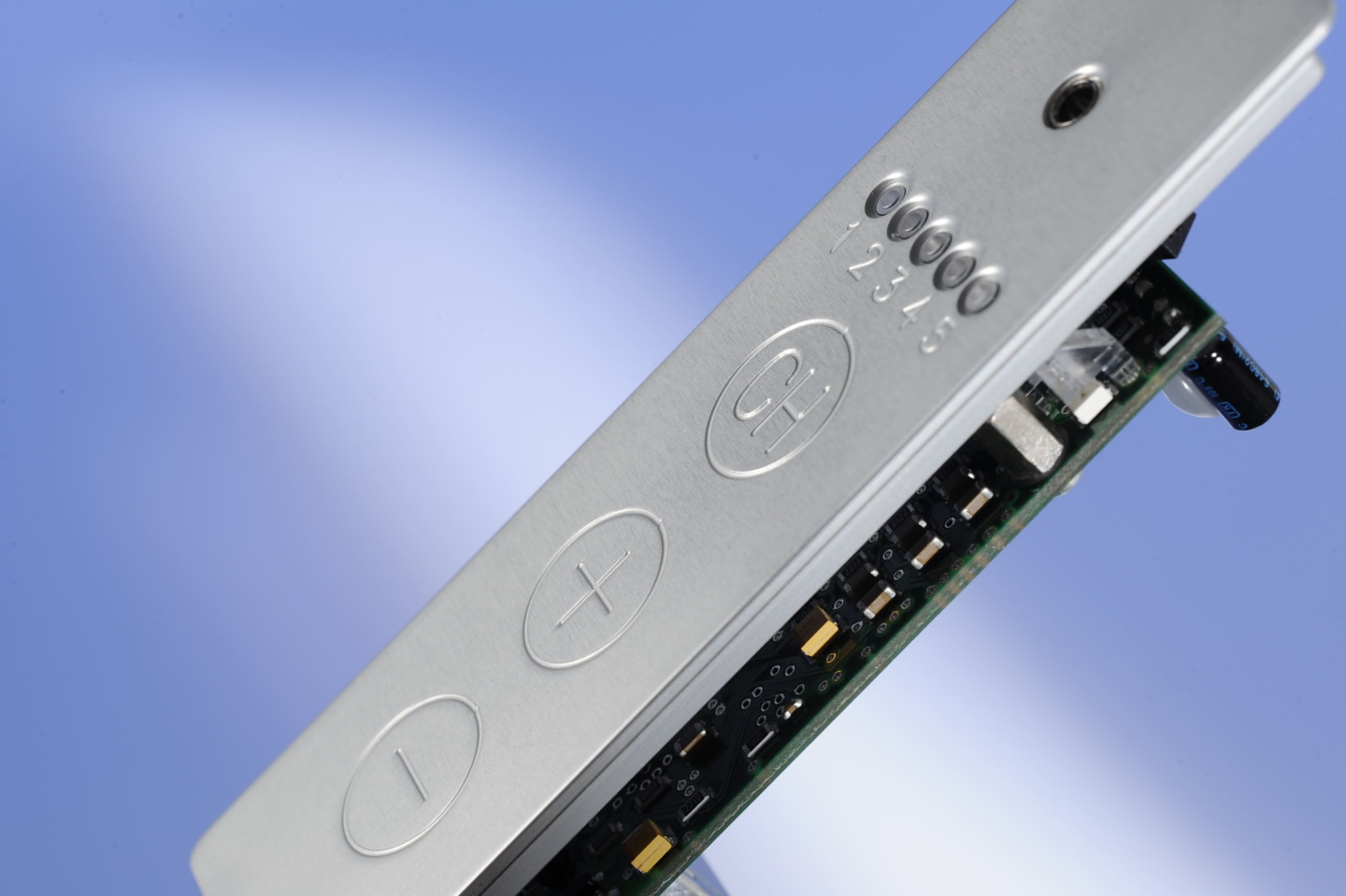
Screentec’s HiUP Electromechanical Film Technology brings a new level of reliability and design freedom to pressure sensing. By focusing on mechanical force detection rather than traditional electrical field-based methods, HiUP enables stable performance even in demanding environments, where moisture, temperature variation, or electromagnetic interference would typically cause challenges.
How HiUP Pressure Sensing Technology Works
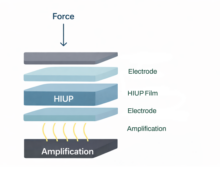
The sensor’s inner capacitance changes under pressure, causing a thickness change in the HIUP Electromechanical film. This change generates a current that is measured and amplified for accurate results.
At its core, HiUP is built on a thin electromechanical film that reacts to applied force. When pressure is introduced, the film undergoes a microscopic change in thickness. This change alters the internal capacitance, generating a current that can be measured and amplified. The result is a highly accurate and responsive sensing method that captures both static and dynamic forces.
Applications of Force Sensing Technology in Industrial and Medical Use
This principle makes HiUP particularly effective in applications where consistent and reliable force detection is critical. It is widely used in vibration monitoring, shock and impact detection, weight and pressure distribution measurement, as well as in industrial assembly and medical or sports-related solutions. Because the sensing is purely pressure-based, the system remains unaffected by water, humidity, or external electromagnetic influences.
Performance of HiUP Sensors in Harsh Environments
AI-generated illustration of a water-repellent surface.
One of the key advantages of HiUP technology is its ability to perform in challenging environmental conditions. The sensors tolerate rapid thermal changes without false triggering, maintaining functionality even when exposed to extreme temperature transitions. They also operate reliably across a wide temperature range, typically from –40°C to +130°C. Moisture does not interfere with performance, and with proper assembly and encapsulation, sensors can function even in submerged conditions.
Material Compatibility and Flexible Interface Design
HiUP also offers exceptional flexibility in product design. The sensors can be integrated beneath a wide range of surface materials, including metals, plastics, rubber, glass, ceramics, wood, and even leather or textiles. This allows designers to combine functionality with aesthetics, enabling seamless and durable user interfaces across industries. Depending on the application, the overlay thickness can vary from less than a millimeter to several centimeters, if the applied force is effectively transferred to the sensor.
Mechanical Design Requirements for Pressure Sensors
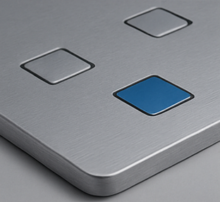
AI-generated concept image of a HIUP sensor integrated into a rigid surface.
From a structural perspective, HiUP sensors require a stable mechanical design where a rigid back plate supports the sensing area. This ensures that applied force creates the necessary deformation in the film to generate a measurable signal. Despite the microscopic scale of the deformation, the system delivers consistent and repeatable results. Sensor sizes can range from extremely small active areas of just one square millimeter to large surfaces covering square meters, and they can be applied to flat, curved, or even convex geometries.
Electronics Integration and Connectivity
Integration into electronic systems is straightforward. The sensor signal is amplified and can be processed through standard electronics such as microcontrollers, enabling everything from simple threshold detection to more advanced interaction logic. Systems can be battery-powered and connected via wireless technologies such as Bluetooth Low Energy, making HiUP suitable for modern, connected devices.
Smart Interaction and Gesture-based User Interfaces
Another strength of HiUP lies in its ability to support intelligent interaction. The sensing system can be calibrated to recognize specific types of input, such as distinguishing between accidental touches and intentional presses based on force and duration. This makes it possible to implement advanced user interactions like gesture control while avoiding false activations caused by vibration or environmental noise.
Integrated Feedback: Haptics, Lighting and Sound
In addition, HiUP supports multiple feedback methods that enhance the user experience. Lighting elements such as LEDs can be integrated directly into the interface, while haptic and audio feedback can be added without compromising sensor performance. This enables the creation of intuitive and responsive interfaces tailored to different use cases.
Durability, EMC Protection and Long-Term Reliability
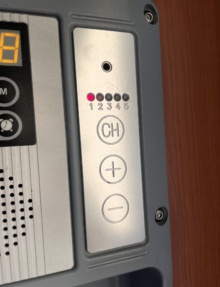
HIUP-based user interface panel in VR railway application, manufactured by Screentec.
Durability is a central aspect of HiUP Electromechanical Film Technology. Through careful material selection and encapsulation, HiUP sensors can be protected against mechanical stress, chemicals, and environmental exposure. They do not emit or receive electromagnetic interference, which allows them to be fully shielded and grounded for applications requiring high EMC performance.
Reference case: HIUP technology in rail applications
Screentec’s HIUP-based user interface panels are successfully implemented in VR train systems, where reliability and precision are critical. The technology enables responsive and durable touch functionality even under demanding conditions such as vibration, temperature fluctuations, and continuous use. This application demonstrates how HIUP sensors deliver consistent performance and long-term stability in safety-critical environments.
Explore how HiUP technology can be tailored to your application, from industrial environments to advanced user interfaces.
CONTACT our expert team to learn more.