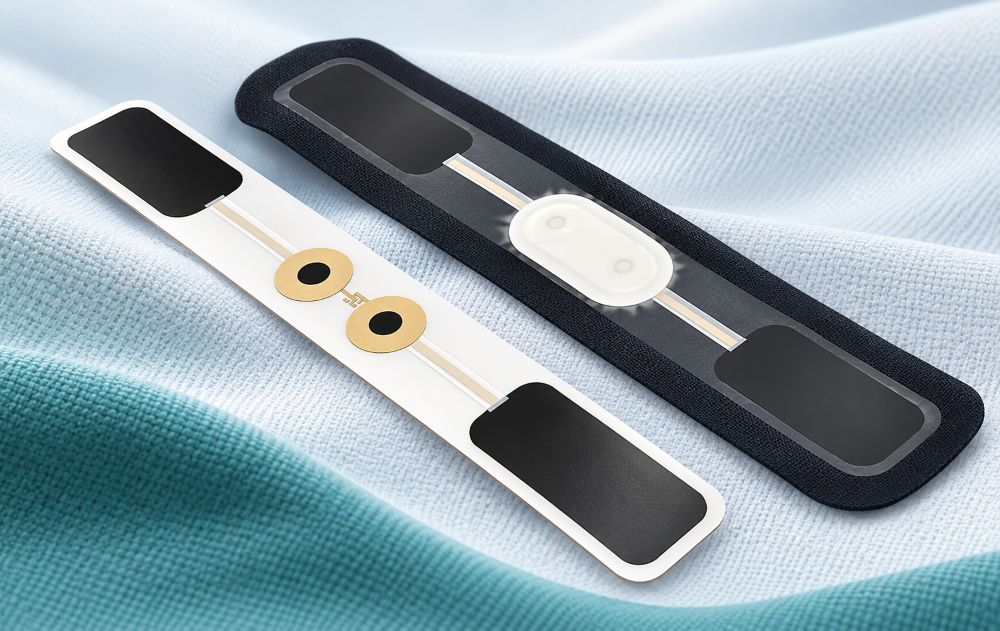
E-textiles, also called electronic textiles or smart textiles, are fabrics that integrate electronic components and functions directly into their structure. Rather than attaching a separate device to clothing or skin, e-textiles embed the sensing, heating, or connectivity capability into the material itself. For product developers working in medical devices, occupational safety, sports science, or consumer wearables, this distinction matters: it changes what is possible in terms of form factor, comfort, and long-term wearability. Understanding how these materials work, where they are being applied, and what it takes to manufacture them reliably is essential before committing resources to development.
This guide covers the full scope of e-textile technology, from the underlying materials and construction methods to the manufacturing challenges that determine whether a concept can scale into a viable product. Whether the goal is a cardiac monitoring garment, a heated protective suit, or a pressure-sensing insole, the same fundamental questions about materials, process, and partner selection apply.
How e-textiles work: materials and construction
E-textiles function by introducing electrical conductivity into fabric through one of several methods, each with different performance characteristics, manufacturing requirements, and trade-offs. The choice of construction method has direct consequences for signal quality, durability, washability, and scalability.
Conductive yarns and woven structures
The most structurally integrated approach uses conductive yarns, typically silver-coated, stainless steel, or carbon-based fibers, woven or knitted directly into the textile. This creates a fabric that conducts electricity as part of its base structure, without any additional processing step. Woven conductive textiles tend to offer good mechanical durability and a natural feel, but achieving precise, reproducible electrical pathways through weaving requires tight process control and is not well-suited to complex circuit geometries.
Printed conductive pathways
Screen printing with stretchable conductive inks enables precise circuit traces, electrode arrays, and heating elements for textile-integrated electronics. Rather than printing directly onto the textile, these functional structures are typically printed onto a flexible TPU substrate, which is then laminated or otherwise integrated into the fabric. Direct printing onto suitable textile substrates is also possible depending on the application and material. This approach provides high design flexibility while combining established printed electronics manufacturing processes with textile integration. Key considerations include material compatibility, adhesion, electrical performance, stretchability, and resistance to repeated bending, washing, and mechanical stress.
Embroidered traces and laminated circuits
Embroidered conductive traces use computer-controlled embroidery machines to stitch conductive thread along defined paths. This is well-suited to low-volume or custom applications but can be difficult to scale and is sensitive to stitch density variation. Laminated flexible circuits bonded to textile carriers represent a different strategy: a pre-manufactured flexible circuit is adhered to the fabric, preserving the precision of conventional PCB-style electronics while gaining some conformability. This approach is common in applications where electronic complexity is high and the textile primarily serves as a carrier rather than an active electrical medium.
Flexible hybrid electronics
Flexible hybrid electronics (FHE) combines rigid electronic components, microcontrollers, wireless modules, power management ICs, with flexible substrates and textile carriers. Rigid components are mounted on small rigid islands within a flexible assembly, connected by stretchable or flexible interconnects. This architecture allows the processing intelligence of conventional electronics to coexist with the conformability that wearable applications demand. The integration of rigid and flexible zones introduces specific reliability challenges at the transition points, which are discussed further in the section on technical challenges.
Key application areas across industries
Smart textile technology is not confined to a single market. The same underlying capabilities, sensing, heating, connectivity, and structural integration, translate across a wide range of industries, each with distinct performance requirements and regulatory environments.
Sports and performance monitoring
Sports science was among the earliest adopters of wearable sensor technology, and e-textiles have extended this further by enabling continuous, unobtrusive monitoring during training and competition. Garments with embedded accelerometers, gyroscopes, and strain sensors can capture movement patterns, posture, and muscle load without restricting natural motion. Biometric signals including heart rate and skin temperature are increasingly captured through textile-integrated electrodes rather than discrete chest strap devices.
Occupational safety and industrial applications
In industrial and hazardous work environments, smart textiles offer a practical route to continuous worker health and safety monitoring. Pressure distribution sensing in footwear or seating can identify ergonomic risk patterns before injury occurs. Environmental sensors embedded in protective garments can detect chemical exposure or extreme temperature conditions. The dual-use potential here is significant: the sensor and heating technologies developed for occupational safety applications overlap substantially with defence and military requirements, including soldier health monitoring, load sensing, and heated protective gear.
Consumer and lifestyle wearables
Consumer applications range from heated outerwear and sleeping systems to posture-correcting garments and stress-monitoring accessories. In this segment, cost, washability, and user experience typically dominate design decisions. The regulatory bar is lower than in medical applications, which allows faster iteration, but the volume requirements are often higher, placing greater pressure on manufacturing scalability and unit economics.
Automotive and seated applications
Printed heating elements on flexible and textile substrates are already used in automotive seat heating systems. The same technology extends to steering wheel heating, door panel integration, and occupant sensing. As vehicle interiors become more connected, textile-integrated sensors for occupant detection, posture monitoring, and comfort management are gaining attention from automotive OEM suppliers.
Medical and diagnostic use cases in focus
Medical applications represent one of the most demanding and technically rigorous segments for e-textiles, and also one of the most consequential. When a smart garment is used to monitor a cardiac patient or deliver therapeutic heat to an injured joint, the performance and reliability requirements are categorically different from consumer wearables.
Cardiac and electrophysiological monitoring
Textile-integrated ECG electrodes allow continuous cardiac monitoring without the adhesive patches or rigid chest straps associated with conventional Holter monitoring. For patients who require days or weeks of ambulatory monitoring, comfort and wearability directly affect compliance, and compliance directly affects diagnostic yield. Electrode performance in this context requires careful attention to skin contact quality, motion artifact suppression, and signal stability across varying skin conditions and perspiration levels. The Ag/AgCl screen-printing and hydrogel formulations used in conventional medical electrodes can be adapted for textile substrates, maintaining the electrochemical interface characteristics that clinical-grade signal acquisition demands.
EMG and neuromuscular monitoring
Electromyography (EMG) garments with arrays of textile-integrated electrodes enable muscle activity mapping for rehabilitation assessment, prosthetics control, and sports medicine applications. The spatial distribution of electrodes across a garment, rather than the fixed positions of adhesive patch arrays, allows more flexible measurement configurations and can reduce setup time in clinical or home settings.
Skin temperature and galvanic skin response
Continuous skin temperature monitoring has gained clinical relevance in wound care, fever surveillance, and metabolic monitoring. Textile-integrated temperature sensors can provide spatial temperature mapping across a wound site or body region, which point sensors cannot. Galvanic skin response, a measure of electrodermal activity related to autonomic nervous system state, is being explored in textile form for stress monitoring and neurological assessment.
Therapeutic heating and drug delivery
Printed resistive heating elements on flexible and textile substrates generate controlled, distributed heat for therapeutic applications including pain management, physical therapy, and wound healing support. Precise control of heat distribution requires careful design of trace geometry, sheet resistance, and power input, parameters that must be validated against the specific substrate and garment construction used in production.
Manufacturing methods and scalability considerations
A concept that performs well in prototype form does not automatically translate into a manufacturable product. E-textile manufacturing introduces process variables that are less familiar to teams with conventional PCB or injection moulding backgrounds, and addressing them early in development is significantly less costly than discovering them at scale.
Substrate consistency and ink adhesion
Textile substrates are inherently more variable than rigid or film-based substrates. Fibre composition, surface texture, weave density, and finishing treatments all affect how conductive ink adheres and how printed traces perform electrically. Achieving reproducible sheet resistance across a production run requires tight incoming material control and process qualification, not just a validated print recipe. This is one of the areas where experience with printed electronics on flexible substrates translates directly into faster, more reliable scale-up.
Connector design between rigid and flexible zones
The interface between a textile-integrated circuit and any rigid electronic module, a sensor IC, a wireless transmitter, a battery connector, is a known reliability risk. Mechanical stress concentrates at these transition points during normal garment use, and failure modes include delamination, trace fracture, and intermittent electrical contact. Connector design for e-textiles must account for the full range of motion the garment will experience, as well as the cumulative effect of washing cycles if the product is intended to be reusable.
Washability and long-term durability
For reusable garments, washability is a hard requirement that must be designed in from the start. Conductive inks, encapsulants, and lamination adhesives vary significantly in their resistance to detergent, mechanical agitation, and thermal cycling in a wash environment. Qualification testing for washability needs to reflect the actual use conditions, including wash temperature, detergent type, and number of cycles, rather than generic durability benchmarks.
Regulatory compliance for skin-contact and medical-classified products
E-textiles intended for medical use must comply with the applicable regulatory framework, EU MDR, IVDR, or FDA 21 CFR Part 820 depending on the market and device classification. Materials in direct skin contact must meet biocompatibility requirements. For ISO 13485-certified volume production, the manufacturing process must be documented, validated, and controlled within a quality management system. These requirements affect not just the final product but the entire supply chain, including the textile substrate, conductive ink, and any embedded electronic components.
Common technical challenges in e-textile development
Product developers entering the e-textile space consistently encounter a set of recurring technical challenges. Awareness of these challenges early in the development process allows teams to make design decisions that reduce downstream risk rather than deferring problems to the manufacturing stage.
Signal quality and motion artifact
Biometric signals captured through textile electrodes are subject to motion artifact, electrical noise generated by relative movement between the electrode and the skin, or by changes in contact pressure during activity. Managing motion artifact requires a combination of electrode design choices (contact area, material, hydrogel formulation), garment construction choices (compression, fit, electrode placement), and signal processing approaches. No single intervention eliminates the problem; effective solutions address it at multiple levels simultaneously.
Power management in wearable form factors
Integrating power supply into a garment without compromising wearability or safety is a persistent design challenge. Battery placement affects weight distribution, comfort, and wash compatibility. Energy harvesting from body heat or motion remains technically feasible but practically limited in the power levels it can deliver for most sensing applications. Power management architecture, duty cycling, low-power wireless protocols, sleep modes, is therefore a critical design consideration from the earliest stages of development.
Reproducibility across production batches
Achieving consistent electrical performance across production batches is more difficult with textile substrates than with conventional PCB manufacturing. Variations in substrate lot, ink viscosity, print pressure, and cure conditions can all shift the electrical characteristics of printed traces. Establishing in-process measurement and control protocols, and defining acceptable performance windows, is a necessary part of the design-for-manufacturing process, not an afterthought.
Regulatory and biocompatibility requirements
For medical wearables, every material in contact with skin must be assessed for biocompatibility in accordance with ISO 10993. This applies to conductive inks, encapsulants, adhesives, and textile fibres, not just the active electronic components. Early engagement with biocompatibility requirements prevents the costly scenario of discovering a material incompatibility after process development is complete. Teams working in this space benefit from manufacturing partners who have prior experience with skin-contact material qualification.
Choosing the right development and manufacturing partner
The complexity of e-textile development, spanning materials science, printed electronics, garment construction, and regulatory compliance, makes partner selection a consequential decision. The right manufacturing partner reduces technical risk, accelerates the path to scalable production, and helps avoid the most common failure modes before they become expensive problems.
Relevant process experience
General electronics manufacturing experience does not automatically translate to e-textile capability. The processes involved, screen printing on TPU substrates, heat lamination process, flexible hybrid electronics assembly, hydrogel application, lamination to non-rigid carriers, require specific equipment, material knowledge, and process know-how. When evaluating a potential partner, it is worth asking specifically about prior work with conductive inks, integrating printed structures into textiles, connector design for flexible-to-rigid interfaces, and washability qualifications.
Regulatory infrastructure
For medical-classified e-textiles, the manufacturing partner’s quality management system must be compatible with the regulatory requirements the product will face. ISO 13485 certification is the baseline for medical device contract manufacturing in most markets. Partners who also have experience with EU MDR, IVDR, and FDA 21 CFR Part 820 requirements can provide practical input on documentation, traceability, and process validation, reducing the burden on the product developer’s own regulatory team.
Prototype-to-production continuity
One of the most common sources of delay in e-textile product development is the transition between a prototyping partner and a volume manufacturer. If the prototype is built using processes or materials that the volume manufacturer cannot replicate, the design must be reworked, at significant cost and time. Working with a partner capable of supporting both prototype development and scaled production, using the same core processes, eliminates this discontinuity. Screentec’s development consulting approach is structured around this principle: feasibility and prototyping work is conducted with production scalability in mind from the outset.
Vertical integration and supply chain control
E-textile products involve a wider range of materials and process steps than most conventional electronic assemblies. A partner with vertically integrated production, where printing, lamination, assembly, and quality control occur under one roof, offers better process control, faster iteration cycles, and cleaner traceability than a supply chain distributed across multiple specialist subcontractors. For regulated products in particular, supply chain complexity is a compliance risk as well as a logistical one.
If the development of an e-textile product, whether a medical monitoring garment, a heated therapeutic device, or an industrial safety wearable, has reached the point where manufacturing feasibility needs to be assessed, engaging a partner with demonstrated capability in printed electronics and textile integration is the most direct path forward.
Discuss your e-textile development project with Screentec’s team to explore what is technically and commercially achievable within your product requirements.
Frequently Asked Questions
How do I know which e-textile construction method is right for my product concept?
The best construction method depends on three intersecting factors: the complexity of your circuit geometry, your target production volume, and your durability requirements. Conductive yarns suit simple, high-durability applications where the textile itself carries the signal; screen-printed conductive inks are better for defined trace geometries and electrode arrays at scale; flexible hybrid electronics (FHE) are appropriate when you need integrated processing intelligence alongside conformability. The most reliable way to determine the right approach is to run a technical feasibility assessment with a manufacturing partner experienced in multiple methods, rather than committing to one architecture based on prototyping alone.
What is a realistic washability target, and how should I test for it during development?
Industry expectations vary by application: consumer wearables typically target 20–50 wash cycles, while medical reusable garments may require 50–100 or more depending on their intended service life. Testing should replicate actual use conditions as closely as possible, including wash temperature, detergent chemistry, mechanical agitation level, and spin speed, rather than relying on generic accelerated aging benchmarks. Critically, washability testing should be conducted on the full assembly, including connectors, encapsulants, and lamination interfaces, not just the printed traces in isolation, since failure most commonly occurs at transition points and bond interfaces.
At what stage of development should regulatory and biocompatibility requirements be addressed?
Biocompatibility and regulatory requirements should be scoped at the material selection stage, before process development begins, not after a prototype has been validated. Discovering that a conductive ink or encapsulant fails ISO 10993 biocompatibility assessment after process qualification is complete forces a costly redesign cycle. For medical-classified e-textiles, engaging a regulatory consultant or working with a manufacturing partner who has prior skin-contact material experience early in development is significantly more efficient than retrofitting compliance into a mature design.
What are the most common reasons e-textile prototypes fail to transition successfully into volume production?
The most frequent failure mode is a mismatch between the materials and processes used in prototyping and those available at the volume manufacturer, requiring a partial or full design rework at the worst possible stage. Other common issues include insufficient process documentation from the prototype phase, substrate variability that was tolerable at low volume but unmanageable at scale, and connector or interface designs that were not stress-tested across the full range of garment motion and washing. Working with a single partner capable of both prototyping and scaled production, using the same core processes throughout, is the most effective way to prevent this.
How is motion artifact managed in practice for biometric monitoring garments?
Effective motion artifact management requires intervention at multiple design levels simultaneously rather than relying on any single solution. At the electrode level, choices around contact area and material surface chemistry affect how stably the electrode maintains electrochemical contact with the skin during movement. At the garment level, keeping the textile-integrated electrode securely in place against the skin is the most important factor in reducing motion artifacts. Appropriate compression, garment fit, and electrode placement relative to the underlying muscle and bone anatomy all help maintain stable contact during movement. Filtering and artifact-rejection algorithms can further improve signal quality, but they cannot compensate for an unstable or poorly designed electrode–skin interface. The best results are achieved when the electrode structure, garment design, and signal processing are optimized together from the beginning.
Can e-textile technology be integrated into products that are not garments, such as insoles, seating, or vehicle interiors?
Yes, and this is already commercially established in several of these formats. Pressure-sensing insoles, automotive seat heating elements, and steering wheel heating systems all use printed or textile-integrated electronics on flexible and semi-rigid substrates. The same core manufacturing processes, screen printing of conductive and resistive inks, lamination, connector design for flexible-to-rigid interfaces, apply across these form factors. The key differences lie in the substrate material, the mechanical stress profile the product will experience, and the regulatory environment, which varies considerably between footwear, automotive, and medical applications.
What questions should I ask a potential e-textile manufacturing partner to assess whether they have genuine capability?
Beyond asking for general credentials, ask specifically about prior experience with conductive ink formulations on textile substrates, how they qualify incoming substrate lots for consistency, what their approach is to connector and interface design for flexible-to-rigid transitions, and how they validate washability for reusable products. For medical applications, ask whether they hold ISO 13485 certification and whether they have experience with skin-contact material qualification under ISO 10993. A partner with genuine capability will be able to discuss failure modes, process control parameters, and past qualification challenges concretely, rather than speaking only in general terms about their equipment or capacity.
This content was generated with the help of AI and it may contain mistakes