
Point-of-care (POC) diagnostic devices are manufactured by fabricating or sourcing the individual components, such as substrates, printed electrodes, membranes, fluidic layers, and electronics, and then integrating them through printing, cutting, lamination, assembly, inspection, testing, and packaging. The exact sequence depends on the diagnostic technology, the assay chemistry, the product architecture, and the intended use. This article explains how those manufacturing steps fit together, what makes production repeatable and scalable, and what developers should clarify before approaching a manufacturing partner. Screentec is a Finnish CDMO with expertise in electrochemical sensors, printed electrodes, flexible electronics, and diagnostic components, supporting developers through contract manufacturing under ISO 13485. Customers retain ownership of final product design, assay development, and regulatory strategy.
How are point-of-care diagnostic devices made? A process overview
Most POC diagnostic devices are built as layered or modular assemblies. Manufacturing generally follows a sequence of stages, although the order and content of each stage vary by platform:
- Material and component preparation: substrates, membranes, adhesives, conductive inks, and housings are specified, qualified, and incoming-inspected.
- Component fabrication: functional layers such as electrodes, conductive traces, and insulation layers are printed, and fluidic features are formed by laser cutting, die-cutting, or molding.
- Sensor or electrode integration: printed sensing structures are combined with the other layers of the device stack.
- Chemistry application: reagents, antibodies, or enzymes are deposited in a controlled step. This is typically developed and supplied by the assay owner, and its handling requirements shape the rest of the process.
- Assembly and lamination: layers, membranes, fluidic components, and in some products electronics are aligned and bonded into the finished structure.
- Inspection and testing: in-process and final checks verify dimensions, alignment, electrical performance, and visual quality.
- Packaging: devices are packaged with desiccant or barrier materials as the chemistry requires.
Not every product includes every step. A simple lateral flow strip has no electronics, while an electrochemical sensor strip may have no membranes, and a cartridge-based system may combine molded parts, sensors, and fluidics. Defining which steps apply to your product is the starting point for any manufacturing discussion.
What types of point-of-care diagnostic platforms are there?
Point-of-care diagnostics are not one manufacturing problem but several, because each platform integrates different components in different ways. The main categories are:
- Lateral flow: a sample moves by capillary action along membranes carrying labeled antibodies and capture lines. The readout is typically visual or read by a reader instrument.
- Electrochemical: printed electrodes measure current, voltage, or impedance changes when the analyte reacts with a functionalized surface. These are common in quantitative testing such as glucose and other metabolite measurement.
- Microfluidic: engineered channels, chambers, and valves handle small, defined fluid volumes, enabling multistep reactions in a compact device.
- Optical: detection relies on fluorescence, absorbance, or reflectance, often combining a disposable test element with a reader instrument and optical alignment requirements.
- Cartridge-based: a disposable cartridge combines several of the above, such as molded fluidics, sensors, and reagent storage, and is processed by an analyzer.
For deeper coverage of individual technologies, see Screentec’s guide to lateral flow assay manufacturing and the article on electrochemical sensors and how they are manufactured.
How do manufacturing requirements differ by platform?
The table below summarizes the key manufactured components, integration considerations, and typical challenges for each platform. It is a general overview rather than a specification for any individual product.
| Platform | Key manufactured components | Integration considerations | Common manufacturing challenges |
|---|---|---|---|
| Lateral flow | Membranes, conjugate and sample pads, backing card, cassette housing | Membrane overlap, flow path continuity, reagent dispensing positions | Reagent line consistency, humidity control, lot-to-lot membrane variability |
| Electrochemical | Printed electrodes, conductive traces, insulation layers, flexible or rigid substrate | Electrode registration, ink and substrate compatibility, connection to reader contacts | Print thickness and geometry repeatability, ink curing, surface condition before functionalization |
| Microfluidic | Channel layers, adhesives, cover films, sometimes molded parts | Layer alignment, bonding quality, fluid-contact materials | Cutting tolerances, adhesive intrusion into channels, leak and bubble control |
| Optical | Test elements, optical windows, reference zones, reader interface features | Positioning relative to the reader optics, material transparency and background signal | Optical consistency of materials, dimensional tolerance, contamination of optical surfaces |
| Cartridge-based | Molded housings, fluidic layers, sensors, reagent storage elements, seals | Combining multiple component types, sealing, interface with the analyzer | Multi-supplier component control, assembly yield, complex test and inspection requirements |
What components go into a point-of-care diagnostic device?
Depending on the platform, a POC diagnostic device may include a substrate layer, a sensing element, a reagent or chemistry layer, a microfluidic structure, a readout mechanism, and in some cases electronics. Each component must work together reliably across the intended sample type and environmental conditions.
 The substrate is usually a flexible film or rigid card that provides structural support. Printed electrodes form the sensing layer in electrochemical devices, with materials such as carbon, silver, or gold chosen based on the target analyte and detection method. These electrodes are typically functionalized with enzymes, antibodies, or other biological recognition elements that react specifically with the analyte of interest. Screentec specializes in printed electrode manufacturing, producing custom sensing layers and flexible electronic components for diagnostic and therapeutic applications.
Fluidic structures, formed through laser cutting, die-cutting, lamination, molding, or embossing, control how the sample moves through the device. The readout layer, whether a visual indicator strip, a connected electrode pad, or an optical window, converts the detection event into an interpretable result. A housing or laminated card holds everything together and protects the chemistry during storage and use.
How are point-of-care devices manufactured at scale?
At scale, POC diagnostic components are manufactured using continuous or semi-continuous processes, including roll-to-roll printing, precision laser or mechanical cutting, automated lamination, and controlled material deposition. These processes allow high volumes of consistent, repeatable components to be produced efficiently, but they are only as good as the repeatability of the underlying steps.
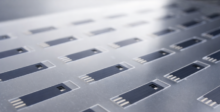
R2R -processed diagnostic devices. Source: Screentec
Roll-to-roll printing is well suited to producing electrode arrays, conductive traces, and functional layers across large areas of flexible substrate. Screen printing deposits conductive inks or functional coatings in precise patterns at high throughput. After printing, substrates are cut to final dimensions using laser or die-cutting equipment, with tolerances tight enough to ensure consistent fluid behavior in fluidic structures and consistent electrode geometry in sensors.
Reagent or chemistry application is typically a separate, controlled step, often performed in a cleanroom or humidity-controlled environment to protect biological materials. Lamination then assembles the individual layers into the finished device structure. Finished devices are inspected, packaged, and stored under conditions that maintain chemistry stability throughout the product’s shelf life. Which of these steps a manufacturing partner performs, and which stay with the device owner or other suppliers, should be agreed explicitly for each project.
Where printing, cutting, lamination, and assembly occur within a single facility, lead times are typically shorter and quality can be controlled more tightly at each step. Screentec’s component manufacturing, printing, cutting, lamination, and assembly operations are located in Oulu, Finland. You can read more about the company’s production services and its work in in vitro diagnostics.
What makes diagnostic device production repeatable and scalable?
Repeatability depends on controlling the variables that directly affect measurement performance. The most important are:
- Process repeatability: print thickness, pattern geometry, cure conditions, and cutting accuracy must stay within defined limits across a run and between runs. For electrochemical sensors, small variations in electrode area or ink thickness can shift the signal.
- Component alignment: registration between printed layers, fluidic features, membranes, and reagent zones determines whether the device behaves as designed. Misalignment is a common cause of yield loss.
- Contamination control: particles, residues, and moisture can interfere with surface chemistry, fluid flow, or optical readout. Handling, environment, and cleaning of materials and tooling all matter.
- Measurement performance: the manufacturing process must preserve the characteristics the assay depends on, such as electrode surface condition, wetting behavior, or optical background.
- Material compatibility: inks, adhesives, substrates, and reagents must be compatible with each other and with the sample, including over the product’s shelf life. Adhesives, for example, can affect assay chemistry if they come into contact with reagents.
- Production scalability: a design that works as a hand-assembled prototype may not run on automated equipment. Choosing materials and geometries suited to roll-to-roll or automated processes early avoids redesign later.
These factors interact, which is why design-for-manufacturability reviews during prototyping are among the most valuable activities in the development process.
What is the difference between prototype fabrication, production transfer, process qualification, and routine production?
These are distinct phases with different goals, and mixing them up is a frequent source of delay.
- Prototype fabrication: small quantities are produced to test design concepts, materials, and performance. Methods may differ from those used in production, and the aim is learning and iteration rather than repeatability.
- Production transfer: the design, materials, and process knowledge are moved to the manufacturing environment and adapted to production equipment. Specifications, drawings, and inspection methods are defined at this stage.
- Manufacturing process qualification: the process is demonstrated to produce conforming product consistently under defined conditions, typically through documented studies. The scope and rigor depend on the product, its risk class, and the applicable quality system.
- Routine production: qualified processes run under change control, with in-process checks, final inspection, and traceability to maintain consistent output over time.
Changes to materials, equipment, or process parameters after qualification may require re-evaluation, so locking down critical decisions before the transfer phase is important.
What should a diagnostic developer clarify before approaching a manufacturing partner?
A manufacturing conversation is far more productive when the developer can answer a few practical questions:
- Which diagnostic platform and detection principle does the product use, and what is the intended use environment?
- What are the critical-to-function dimensions, tolerances, and performance requirements the manufacturing process must protect?
- Which materials are fixed by assay performance, and which are open to change for manufacturability?
- Who is responsible for reagent supply and application, and how sensitive is the chemistry to humidity, temperature, and time?
- What volumes are expected at launch and at scale, and what is the planned ramp?
- Does the product include electronics or a reader interface, and how will the disposable component connect to it?
- What inspection, test, and release criteria apply to the finished component or device?
- What is the status of the design: concept, working prototype, or frozen design ready for transfer?
- Which regulatory pathway applies, and what documentation or quality system expectations will the supplier need to support?
Having even partial answers allows a manufacturing partner to assess feasibility, identify risks, and propose realistic next steps.
What quality and regulatory considerations apply to POC diagnostic manufacturing?
Devices classified as in vitro diagnostics are generally subject to a quality management framework such as ISO 13485, together with regional regulations, for example the EU IVDR (Regulation (EU) 2017/746) in Europe and FDA requirements in the United States. Which requirements apply, and how, depends on the product, its intended use, its risk classification, and the market. There is no single universal checklist.
In general, design controls, supplier management, risk management, process validation, and traceability need to be in place throughout development and production rather than added at the end. Documentation that is not created during development is difficult to reconstruct later, and late design changes made without documented justification can force rework.
Responsibilities should be clearly divided. The device owner typically retains ownership of final product design, intended use claims, clinical evidence, and regulatory submissions. A contract manufacturer provides manufacturing processes within a quality system and supports the documentation related to its own activities. Agreeing on these boundaries early, ideally in a quality agreement, avoids misunderstandings later.
How long does it take to go from prototype to production for a POC device?
The timeline from prototype to commercial production for a point-of-care diagnostic device typically ranges from 18 months to several years, depending on device complexity, the maturity of the detection chemistry, the regulatory pathway required, and how early manufacturing considerations are integrated into development.
An electrochemical or microfluidic IVD device with established chemistry and a well-defined regulatory pathway can reach production in 18 to 24 months when development is well managed and a capable manufacturing partner is engaged from the prototype stage. More complex devices, or those requiring clinical performance data for regulatory submission, commonly take three years or longer.
The stages that most often extend timelines are design iteration during prototyping, process validation before scale-up, and regulatory review. Designing for manufacturability from the first prototype reduces redesign cycles. Running process validation in parallel with regulatory documentation rather than sequentially can save months. Choosing the right regulatory strategy before development begins helps avoid discovering midway through that additional clinical evidence is required.
Working with a CDMO that has experience across the development cycle, from prototype through validated production of components, reduces the risk of delays caused by gaps between development and manufacturing capability. If you are evaluating manufacturing partners for your POC diagnostic project and want to discuss sensor integration, component manufacturing, or production feasibility, we’d be glad to talk.
This content was generated with the help of AI and it may contain mistakes